
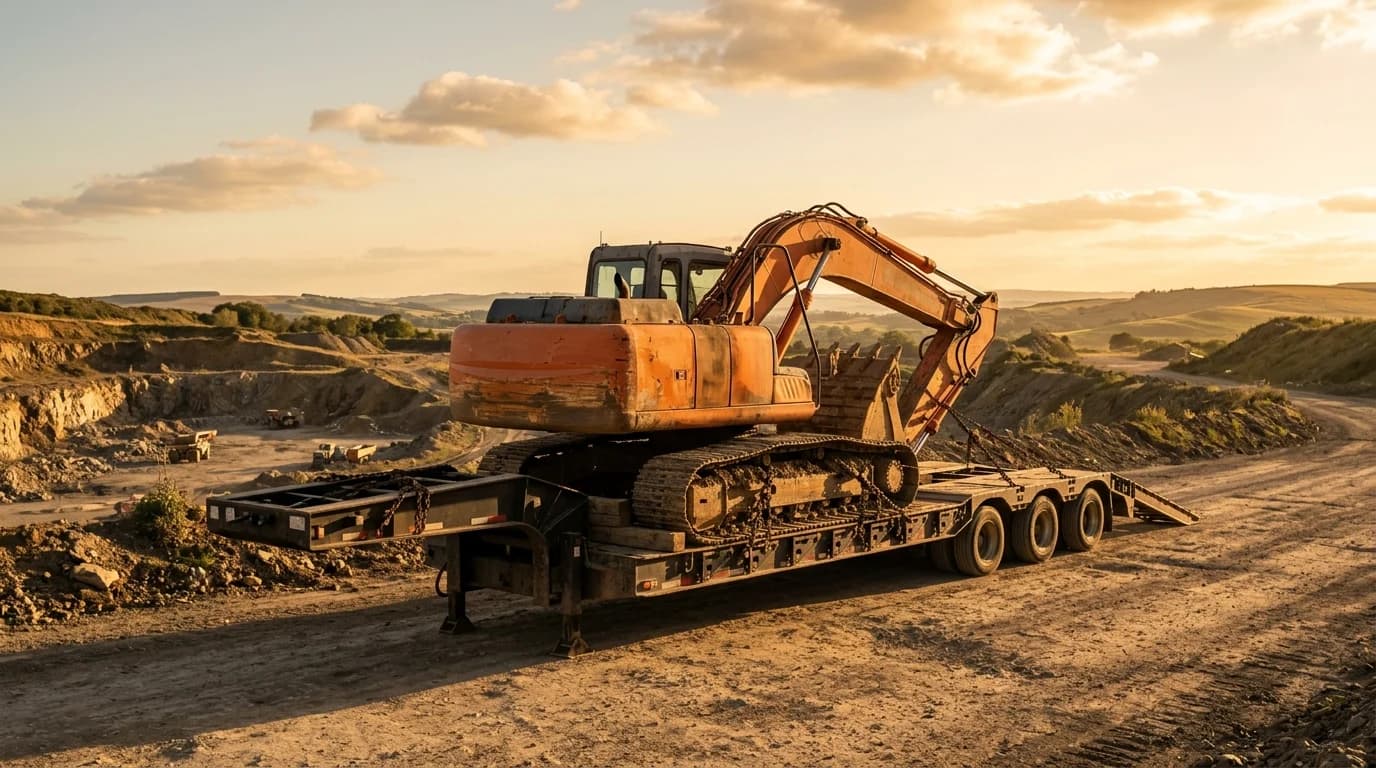
How to Transport an Excavator
Learn the width, weight, and permit limits that decide which machine you can haul, and why transport costs can wipe out an auction bargain.
Transport is a hard constraint on which machine you can actually own, and a real cost on every auction purchase.
The Legal Thresholds That Matter
These are typical US rules, and states vary.
- Width up to 8 ft 6 in (2.59 m). At or under this width, you need no oversize permit on most roads. Every mini and midi excavator fits. Nearly all 20-ton-class machines are 2.8–3.0 m wide, so they run as permitted oversize loads.
- Gross combined weight of 26,001 lb. Above this, you generally need a CDL. A pickup, trailer, and 4 t mini can stay under it. A midi usually pushes past.
- 80,000 lb gross on interstates without overweight permits. A tractor, lowboy, and 36 t excavator together exceed it, so large machines move on permitted multi-axle setups.
Practical Truck and Trailer Pairings
- A mini of 4 t or less pairs with a heavy pickup (¾–1 ton) and a 10–14k equipment trailer.
- A mini or midi of 4–9 t pairs with a medium-duty truck or small tractor and a 14–25k tag trailer.
- A standard machine of 13–24 t goes on a tractor and a lowboy or RGN, with an over-width permit in most states. Expect $500–2,000 per regional move, and more to go cross-country.
- A large machine of 25 t or more moves as a permitted oversize/overweight load, sometimes with escort vehicles. Plan on thousands per move.
How Transport Affects Your Buying Decision
- A remote auction machine that needs a 1,000-mile permitted haul can erase an apparent bargain. Always price the haul before you bid.
- Removing the boom/stick and counterweight can bring a large machine under weight limits, but it adds rigging cost at both ends.
- Check transport height too. 20-ton machines fold to about 3.0–3.2 m, so verify the total loaded height against 13 ft 6 in (4.11 m) bridge clearance on your route.
General guidance to help you shop — figures are typical ranges, not a valuation. Confirm the specifics of any machine with the seller before you buy.
More Guides
What Size Excavator Do You Need?Match the machine to the job. See how dig depth, reach, lift, site access, and transport point you to a mini, midi, standard, or large excavator.Excavator Size Classes ExplainedCompare mini, midi, standard, and large excavators by operating weight, dig depth, and engine power, and see what each class is best at.Excavator Hours, Lifetime, and ConditionLearn what the hour meter tells you, which components cost real money (undercarriage, final drives, and hydraulics), and how to spot a re-metered machine.