
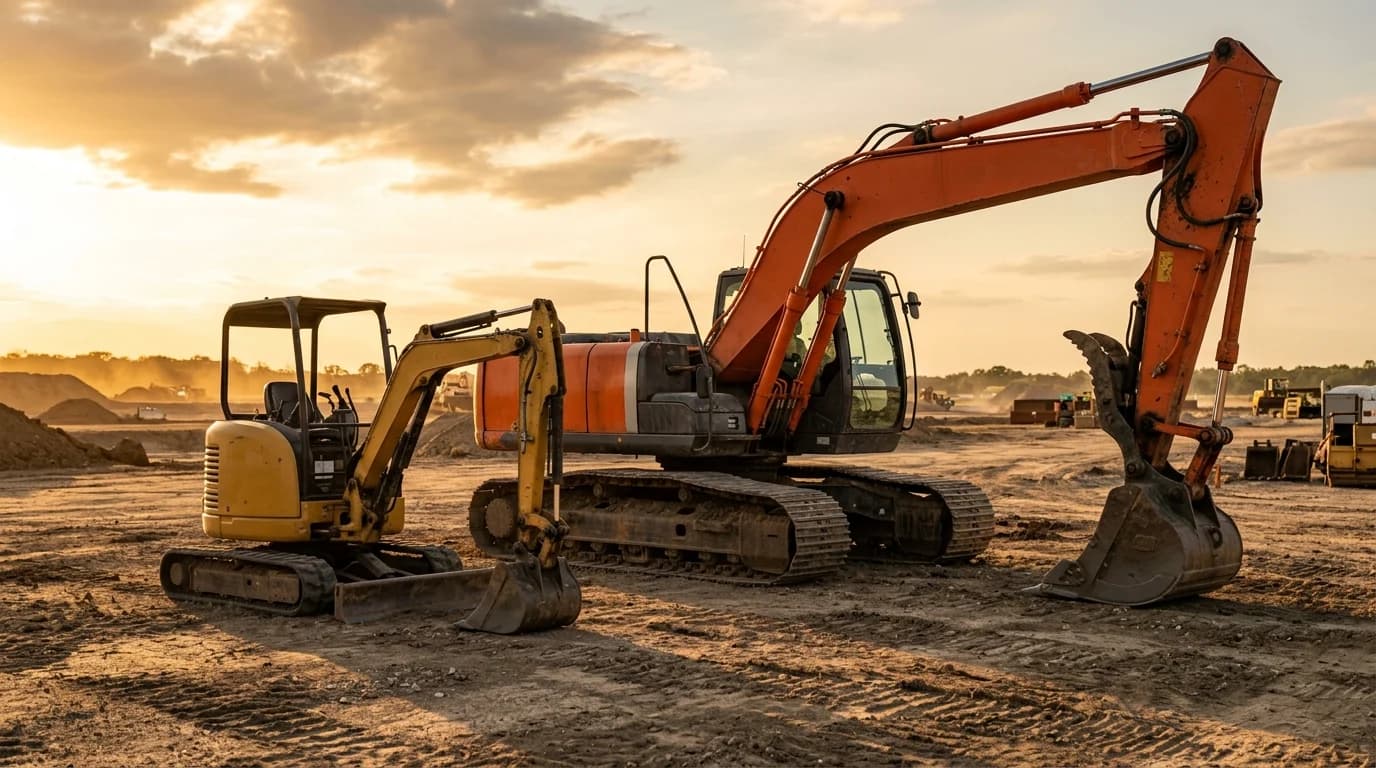
What Size Excavator Do You Need?
Match the machine to the job. See how dig depth, reach, lift, site access, and transport point you to a mini, midi, standard, or large excavator.
Match the work to the machine. Describe the job, and the choice comes down to dig depth, reach, weight class, tail swing, and transport. This guide walks you from the trench you have to dig to the class of machine that digs it.
Depth-Driven Jobs
As a rule of thumb, the machine's maximum dig depth should exceed the depth you need by 15–20%. Spec-sheet depth is measured at the ideal position with a flat bottom stroke, and real trenches need over-dig for bedding and shoring.
- For irrigation, electrical, and gas laterals 0.5–1.2 m (2–4 ft) deep, any mini will do.
- For water and sewer laterals and septic work 1.5–2.5 m (5–8 ft) deep, use a large mini (4–6 t) or a midi. Choose the midi if spoil must be cast away from the trench.
- A residential basement means digging 2.4–3 m (8–10 ft) plus over-dig. The midi class is the practical floor, but a standard 13–20 t machine is the right answer. For example, if you describe the job as "dig 18-ft basements," you need about 5.5 m of true dig depth. That points to a 20-ton class machine (6.5 m or more of maximum dig depth). If the job is "18-ft basements in tight lots," add reduced or zero tail swing. That points to a Komatsu PC138US-class machine, for example, or a CR or US variant of a 13–22 t machine.
- Deep sewer mains at 5–7 m call for a 20–36 t machine. Check reach too, because depth without reach means constant repositioning.
- Ponds, canals, and dredging call for a long-reach configuration. Here reach matters more than depth.
Reach- and Lift-Driven Jobs
- To load trucks, the machine must out-reach the truck's side wall. A 20-ton machine loads standard dump trucks comfortably. A mini cannot.
- When you set pipe or structures, check lift charts, not just weight class. Lifting over the side on a zero-tail mini is the weakest case.
- In demolition, weight class buys stability and attachment capacity (breaker and shear weight). Plan on 20 t minimum for single-story structural demolition.
Site-Constraint Driven Choices
- If the access gate or side yard is under 1.8 m, you need a mini with a retractable undercarriage or a width under 6 ft (Bobcat E35 class or smaller).
- If you work against walls, property lines, or traffic, choose reduced or zero tail swing (see the tail-swing guide).
- On soft ground or finished surfaces, use rubber tracks (on minis and midis) or bolt-on pads.
- Inside structures or under low overhead, check cab height and consider a canopy. Fixed cab heights on minis run about 2.4–2.6 m.
Production-Driven Sizing
Moving dirt comes down to bucket size times cycles. A 20-ton machine with a bucket of about 1 m³ moves roughly 8–10 times what a 3.5 t mini (about 0.09 m³) moves per hour. Undersizing a mass excavation job costs far more in labor-hours than the difference in rental or purchase cost.
Transport as a Constraint
If you own only a pickup and a 10,000-lb trailer, cap your choice at about 4 t operating weight. A midi (8 t) needs a 14,000–16,000-lb tag trailer and a medium-duty tow vehicle. Anything in the standard class rides a lowboy. If you don't own one, every move is a hired haul. That argues for the biggest machine that stays on site, or for the smallest machine that does the job when it moves weekly.
General guidance to help you shop — figures are typical ranges, not a valuation. Confirm the specifics of any machine with the seller before you buy.