
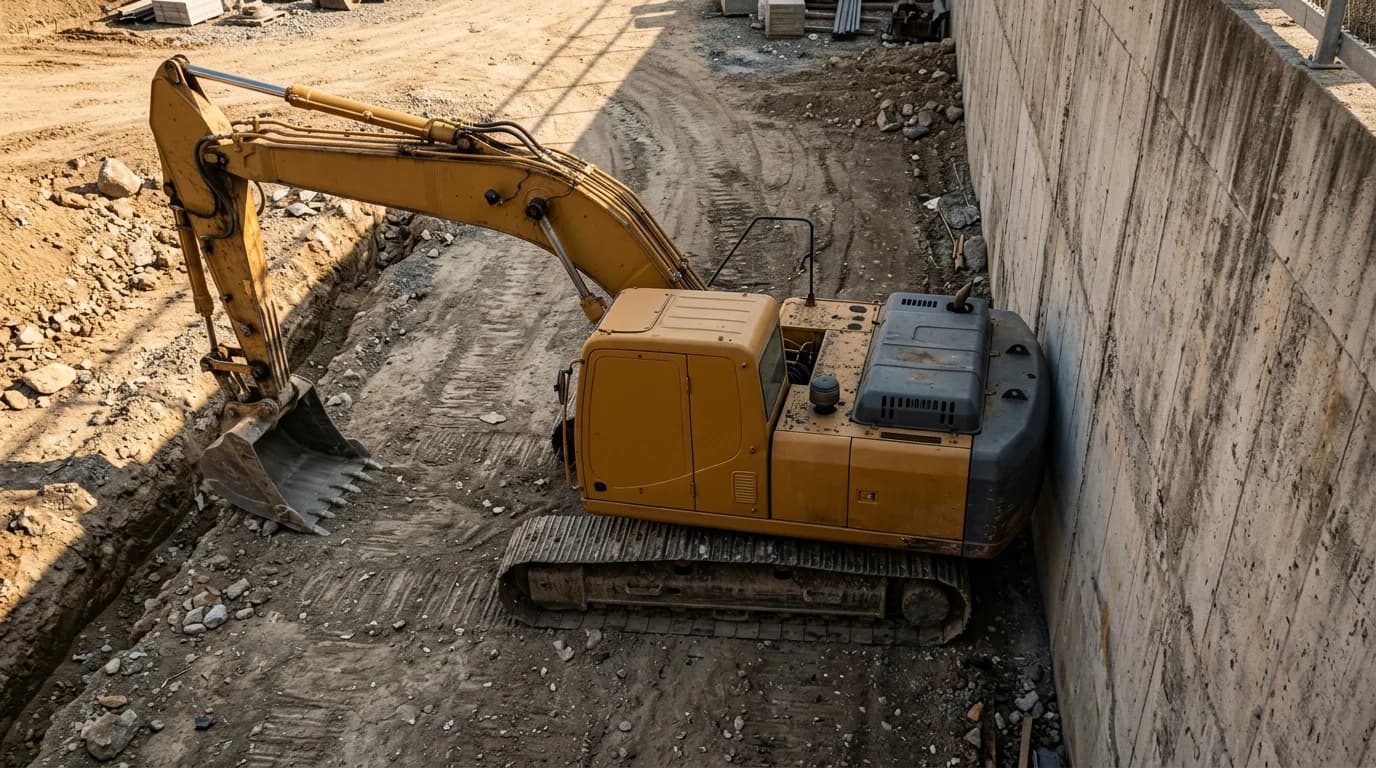
Conventional, Reduced, or Zero Tail Swing?
See how tail swing changes where an excavator can work, and when a reduced- or zero-tail machine is worth the extra money over a conventional one.
Tail swing is how far the machine's counterweight (the rear of the "house") extends past the tracks when the upper structure rotates.
Conventional Tail Swing
The counterweight overhangs the tracks significantly, often 0.5–1 m on a 20-ton machine. Conventional designs are cheaper and more stable. Because the counterweight sits farther back, they also lift more for the same weight. They're fine for open sites such as mass excavation, rural utilities, pads, and pits.
Reduced (Tight) Tail Swing
The counterweight overhang is cut to roughly 15 cm or less past the tracks. For the same dig specs, a reduced-tail machine is slightly heavier and more expensive. The Kubota KX080 ("tight tail"), Cat CR models, Komatsu US models, Deere 85G, and the Volvo ECR series are examples. Reduced tail swing is the right default for road and urban work.
Zero Tail Swing (ZTS)
The house stays entirely within the track width through a full 360° rotation, so there's nothing to hit behind the machine. Zero tail swing is common in minis, such as the Bobcat E-series, Kubota U series, Yanmar ViO, and Deere G compacts.
It comes with trade-offs. You get slightly less lift capacity over the side and a more cramped engine compartment, so check service access. You also carry more weight for the same dig envelope.
When Tail Swing Matters
Here is how the words in a job description translate into a tail swing spec.
- If the job is on a "tight lot", "against a wall or fence", "between houses", "inside a building", "next to live traffic", or "working off one lane", specify reduced or zero tail swing.
- For an "open field", a "new development site", or "pit work", conventional is fine and usually the better value. Don't pay the zero-tail premium.
- Digging alongside a structure also depends on the boom and offset configuration, not just tail swing. Minis with swing booms can dig flush against a wall.
General guidance to help you shop — figures are typical ranges, not a valuation. Confirm the specifics of any machine with the seller before you buy.